


GENRE
Bullet Hell
2026 – 4 weeks
Boss Fight Prototype
Father of the Sons of Man
01 Overview
Father of the Sons of Man is a third-person bullet hell boss fight developed over three weeks by a team of four designers. My role in the team was Technical Designer, where I mainly worked on the systems needed to build the boss fight.
Most of my work went into creating the projectile system used for the boss attacks. I built it to be modular and data-driven, making it easier for us to create and change different attack patterns. I also worked on the boss AI, implemented supporting gameplay systems and helped bring the different parts of the fight together into the final encounter.

Team Size
FOCUS
MY CONTRIBUTION
MY ROLE
GAME ENGINE
4
-
Gameplay
-
Systems
-
AI
-
Bullet Hell Framework
-
Procedural Projectile Patterns
-
Boss AI
-
Systems Integration
-
Player Mechanics
-
Technical Support & Iteration

Technical Designer
02 Bullet Hell System
Our boss fight was built around a third-person bullet hell mechanic, so we needed a way to create many different projectile patterns without building each one from scratch.
I created the math used to calculate the position and direction of each projectile. Using the same system, we could then create different patterns such as arcs, rings and spheres by changing how the projectiles were calculated and spawned.
Arc Pattern Calculation
Distributes projectiles across a configurable angular range.
Ring Pattern Calculation
Distributes projectiles evenly around a 360° formation.
Sphere Pattern Calculation
Extends projectile distribution across multiple axes to create a spherical burst.
02.1 Data-Driven Attacks
Once the different projectile patterns were working, I moved the attack creation into Data Assets. I wanted our Combat Designer to be able to create and change boss attacks without having to go into the underlying Blueprint logic.
Each Data Asset contains the settings needed for an attack, such as the projectile pattern, amount of projectiles, radius, angle, tilt, number of bursts and velocity. Changing these values allowed us to create many different attacks using the same underlying system.
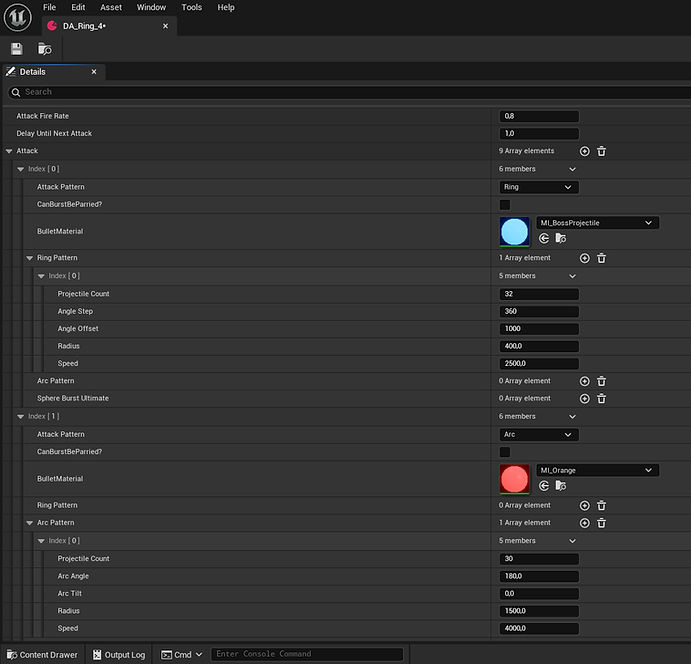
Design goal
Keep attack design separate from the underlying implementation, making it easy for the Combat Designer to create and change attacks without having to modify the Blueprint logic.
Demonstrating parts of an attack used by the boss.

03 Boss AI & Encounter Logic
With the individual boss attacks handled by the bullet hell system, my next task was to implement the boss behavior designed by our Combat Designer.
I built the boss AI using a Behavior Tree, AI Controller and AI Perception. These systems handle when the boss should attack, how it reacts to the player and when it should transition between the different phases of the fight.


03.1 Phase-Specific Behavior
During the first phase, the boss needed to react when the player used the large pillars in the arena as cover. I used AI Perception together with the Behavior Tree to detect and take action when the boss lost sight of the player.
Instead of continuing its normal attacks, the boss responds by targeting and destroying the pillar blocking its view. This removes the player's cover and forces them to move before the boss returns to its normal behavior.
Destruction Response Behavior
During the second phase, we wanted the boss to reposition whenever the player got too close. The boss does this by teleporting between predetermined locations around the arena.
I created reusable teleport point Blueprints that the designers could place wherever they wanted in the level. When the player gets too close, the boss selects one of these locations, teleports to it, perform a special attack and then continues its normal combat behavior.
Teleport Response Behavior
04 Learning & Reflection
This project definitely pushed me a few meters outside of my technical comfort zone, especially when I started working on the projectile system. I didn't have much experience using vector math to this extent before the project, so a lot of it was learned through experimentation and iteration. By the end I was able to use it to create configurable projectile patterns such as arcs, rings and spheres.
Another thing I learned was when to stop pursuing a technical solution. I spent some time experimenting with projectile pooling as a way to improve performance. It ended up causing more problems for the existing bullet hell system than it solved, and the performance benefit wasn't large enough to justify the extra complexity. Since we only had four weeks, I decided to scrap it and spend that time on systems that would actually contribute to the finished boss fight.
The project also reinforced what I enjoy about Technical Design. I like building systems that make it easier for other designers to do their work. Instead of manually creating every boss attack myself, I built the framework and tools that allowed our Combat Designer to create and change attacks independently, while I could focus on the systems behind them and making everything work together.
